
Last updated November 20, 2026
 Raised-panel steel
 Carriage house
 Modern flush
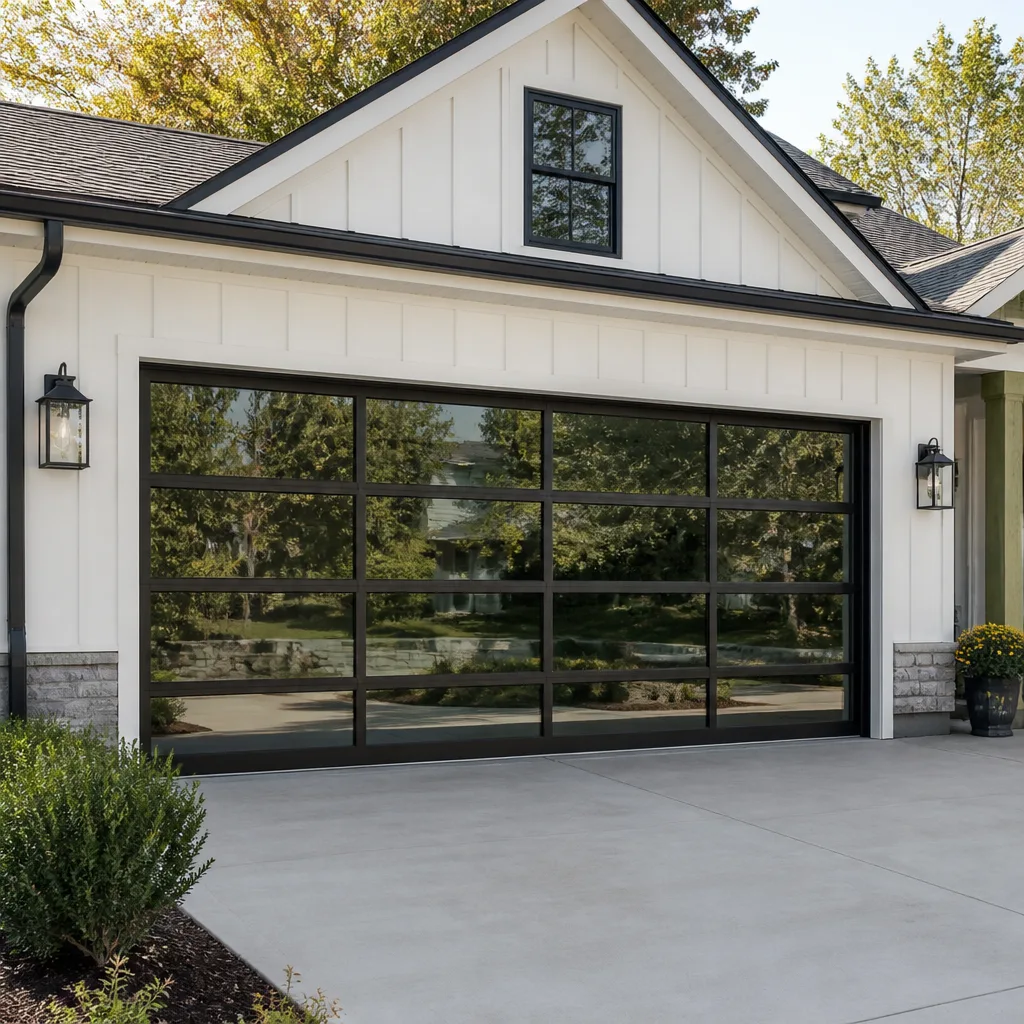 Full-view glass
 LiftMaster openers
 Chamberlain openers
Full 25-point door and opener safety check with every visit - springs, cables, rollers, tracks, and your LiftMaster or Chamberlain opener included
You get a price before we start. It does not change when the pro arrives.
Get your free estimateGarage Door Warning Signs: An Akron Homeowner’s Reference Guide
Most garage door failures don’t happen without warning. They announce themselves first – a new sound, a slight hesitation, a door that slams the last few inches instead of settling gently. The problem is that homeowners read these signals as normal wear or a minor annoyance, and by the time the door stops moving entirely, the damage has spread from one component to three. A garage door that just slams the last few inches isn’t settling in; it has a broken or disconnected spring tension system, and the full weight of the door is transferring to the opener motor, which will fail next. This guide decodes what the sounds, movements, and visual cues in your Akron garage are actually telling you, at the component level, so you can act on the signal instead of the breakdown.
Quick Answer
The most serious garage door warning signs in Akron are a sharp bang followed by a door that won’t lift, a door that reverses before closing, visible cable slack or an uneven gap at one corner, and rhythmic squealing that gets louder over weeks. Any of these points to a spring, cable, track, or opener problem that gets more expensive the longer it’s ignored. A grinding noise or slow-down-on-the-way-up pattern is an earlier warning that the tension system is out of balance.
Styles & brands we work with
- Raised-panel steel
- Carriage house
- Modern flush
- Full-view glass
- LiftMaster openers
- Chamberlain openers
Table of Contents
- The Sound Diagnostic Index: What Each Noise Means
- Visual Asymmetry: Reading an Uneven Door
- Opener Behavior Flags That Aren’t Sensor Problems
- The Slow-Up, Fast-Down Pattern
- Rust and Weather Damage in Akron’s Climate
- Track and Roller Wear You Can See
- When a Warning Becomes an Emergency
- Common Mistakes to Avoid
The Sound Diagnostic Index: What Each Noise Means
Your garage door makes a predictable set of sounds when it’s healthy. When a new sound appears and stays, it maps to a specific component. Listen before you look, and you’ll usually know which part of the system is under strain before you ever see it.
Grinding
A grinding noise during travel is metal-on-metal contact. The usual suspects are dry or seized rollers, a bent track section the roller is scraping, or a torsion bar that has shifted in its bearing plates. Grinding rarely means the door is about to fall, but it accelerates wear fast because the friction is chewing through the same spot every cycle.
A Sharp Bang
A single sharp bang from inside the garage, followed by a door that won’t open or feels suddenly very heavy, is the classic torsion spring break. That’s the sound of the spring letting go. It’s the most serious warning on this list because the door is now held only by the opener, and an opener isn’t built to lift the full dead weight of a door. Stop using the door and call for spring repair.
Rhythmic Squealing
Squealing that pulses once per revolution points to a dry roller or a bearing that’s losing lubrication. It’s an early, low-cost fix if you catch it, and a track-and-roller replacement if you don’t. It gets louder over weeks, not minutes, which is why so many homeowners tune it out until the door starts to bind.
A Low Hum With No Movement
If you hear the opener motor humming but the door doesn’t move, the motor is running and the drive isn’t engaging. That can be a stripped gear in the opener, a broken drive belt or chain, or a manual release that’s been pulled. On a LiftMaster or Chamberlain unit, this often traces to the travel module or a worn gear set rather than the motor itself, which is why garage door opener repair usually solves it without a full replacement.
Visual Asymmetry: Reading an Uneven Door
A garage door that looks slightly crooked is telling you exactly which side of the mechanism has failed. Stand back and look at the door the way you’d look at a picture frame on a wall. One corner low, one side higher, a visible gap where the door meets the floor – each pattern has a different cause.
One Side Lower Than the Other
If the left or right edge of the door sits lower than the other, the torsion system is out of balance or one of the two cables has stretched. On a properly balanced door, both cables carry equal tension. When one relaxes, that side drops, and the door twists slightly through its travel. A door run this way long enough will wear one track faster than the other.
Visible Cable Slack
Look at the cables that run down each side of the door to the bottom brackets. They should be uniformly taut. A cable that hangs loose, or one that’s clearly looser than its partner, is a warning you should treat as urgent. Cables on a torsion system are under high tension; slack means the system is already partly compromised. Don’t try to adjust them yourself – this is the part of the door that injures homeowners.
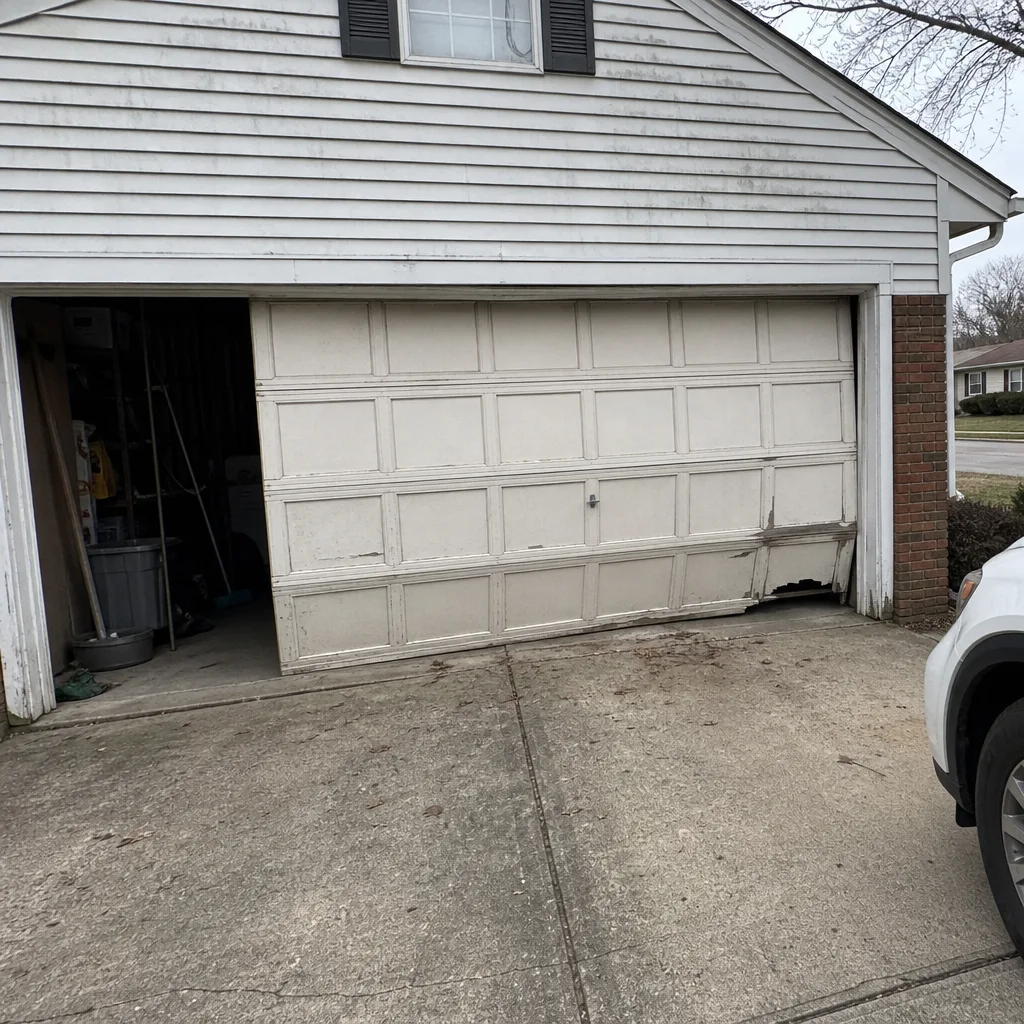
A Gap at One Corner
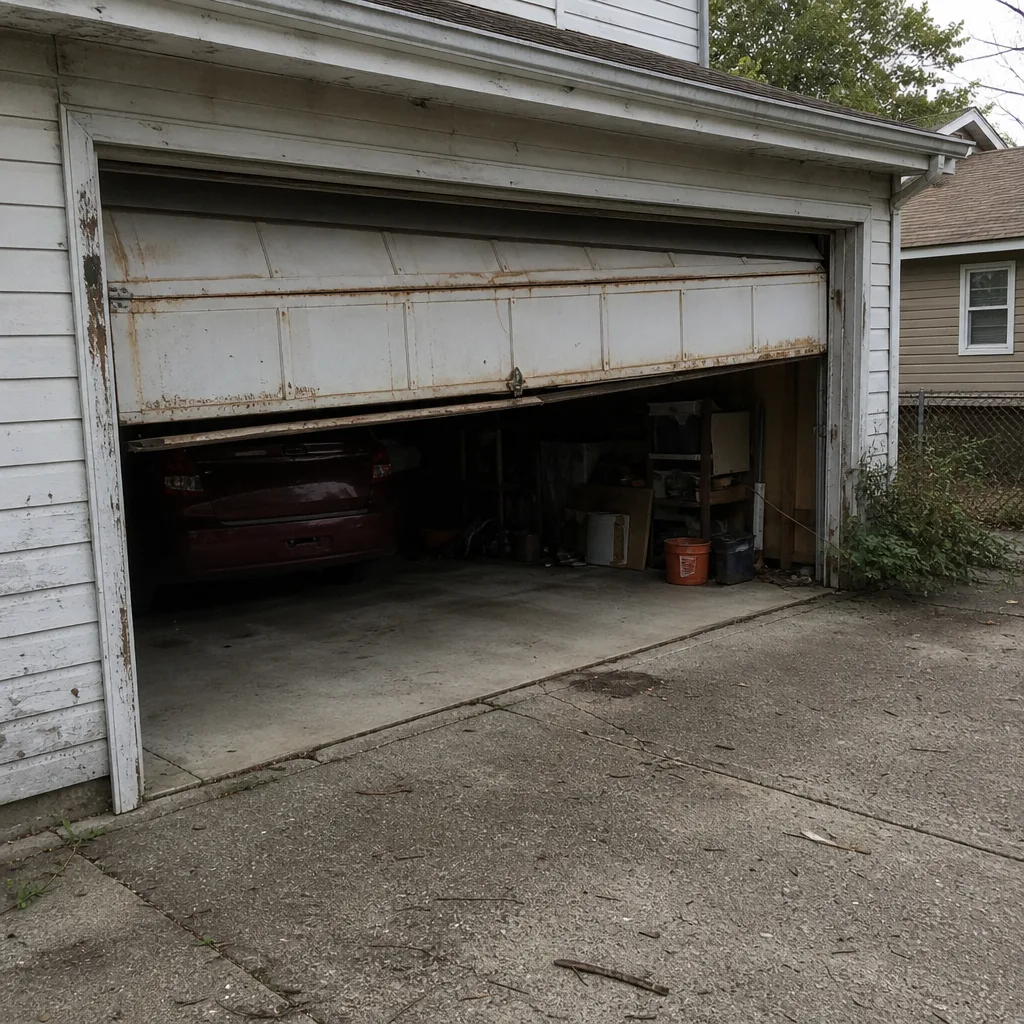
A wedge-shaped gap between the door and the floor usually means the door is racked – one corner has pulled away from square. That can come from a snapped cable, a track that’s bent, or a hinge that’s failed and let the panel shift. The gap itself matters for weather, but the racking behind it matters more for safety.
What you can check safely is whether the gap changes when the door is halfway up versus fully closed. If it does, the door is out of square and needs a professional look. In our experience, an uneven door that’s been left alone for a few weeks usually needs more than one component replaced by the time we see it.
Opener Behavior Flags That Aren’t Sensor Problems
A door that reverses before it closes gets blamed on the safety sensors about nine times out of ten, and it’s the sensors only some of the time. When a homeowner calls us about a door that backs up on its own, we check three other causes before the sensors, because on a modern opener those three are more common.
- Travel limit settings drifted. The opener’s down-limit tells it how far to go. If that limit has moved, the opener reads the floor as an obstruction and reverses. This shows up after a power surge or a door that’s been re-adjusted by hand.
- Logic board fault. A failing board can send false reverse signals. On a Genie unit, this often shows as an intermittent reverse that gets more frequent over a few days. On a LiftMaster or Chamberlain, it tends to be consistent rather than intermittent.
- Force sensitivity set too tight. The opener measures resistance as the door closes. If the force setting is at its most sensitive, a slightly stiff roller can trip it every cycle. This one shows up especially in cold weather, when the door moves with more resistance.
Only after those three do the sensors come into play – a sensor knocked out of alignment, lens fogged by condensation, or a wire nicked by a stored object. If your door is a Raynor or a Craftsman and the reverse is consistent, don’t assume a full replacement. Most opener faults are diagnosable and repairable, and repairing first, replacing only when necessary, is the approach that saves you the most money.
The Slow-Up, Fast-Down Pattern
Watch the door travel. A balanced door moves at roughly the same speed up and down, with a gentle settle as it reaches the floor. A door that strains slowly up and drops quickly down is out of balance, and the spring tension is the reason. This pattern is the single most useful early warning in this guide, because it appears weeks before a spring fails outright.
Here’s what’s happening. The torsion spring is what counterbalances the door’s weight – it stores energy as the door closes and releases it as the door opens. When the spring loses tension, the opener has to do more of the lifting, so the door climbs slowly. On the way down, the door’s own weight is dropping with less counterbalance, so it falls fast and jams into the floor or the opener’s force limit stops it hard. That impact is what eventually cracks a hinge or cracks a panel seam.
Two things make this pattern worth catching early:
- It accelerates track and roller wear. A door that lands hard rocks slightly on impact, and the rollers hammer against the track on every cycle. What starts as a spring problem becomes a track-and-roller problem within a few months.
- It strains the opener’s gear and rail. The opener is now lifting a door it wasn’t sized for. On a belt-drive opener this shows up as belt stretch; on a chain drive, as sprocket wear.
This is a fast, safe check. Watch one full open-and-close cycle from outside the door path – never put your hands near the moving door or the springs. If the up-and-down speeds are visibly different, that’s enough to call for a balance check.
Rust and Weather Damage in Akron’s Climate
Akron’s winters bring freeze-thaw cycles, road salt tracked into garages, and long stretches of high humidity in summer. That combination is hard on the metal components of a garage door, especially the torsion bar hardware, the bottom brackets, and the hinges. Not all rust is an emergency – some is cosmetic – but the location of the rust tells you which kind you’re looking at.
Surface Rust vs. Structural Rust
- Surface rust is a thin orange film on the door panels or the track face. It’s cosmetic and doesn’t affect function. Wiping it down and touching up the paint is usually enough.
- Structural rust is flaking, pitting, or a rusted-through section on the torsion bar, the bearing plates, the hinges, or the bottom brackets. When any load-bearing piece of that hardware has lost metal, replacement is non-negotiable – it’s not a maintenance item anymore.
Pay particular attention to the bottom brackets. They sit near the floor where melting snow and salt pool, and they carry cable tension. A rusted bracket is the component most likely to fail suddenly in a way that’s dangerous to anyone nearby. If the bracket is flaking or has visible pitting, don’t use the door until a technician looks at it.
Akron’s freeze-thaw swings also work the door’s weather seal and bottom rubber. A seal that cracks in winter lets meltwater in, and that water refreezes against the bottom bracket – the exact spot you can least afford ice. A visual check of the brackets and the seal each fall catches most of this before it gets expensive.
Track and Roller Wear You Can See
The track and roller system is the most visible part of the door, which makes it the easiest to check and the most commonly ignored. A healthy track is straight, clean, and evenly spaced from the door on both sides. Worn rollers are the cause of most of the noise and vibration homeowners describe as “just an old door.”
What to look for:
- Bent track sections – a visible kink or a section that’s been pushed out of line. A door that hit an obstacle or was backed into by a car will usually show this at the same height on both sides.
- Rollers out of their track – the roller stem should sit inside the track channel. One that’s popped out points to a bent track or a hinge that’s failed.
- Flat-spotted or cracked rollers – a nylon roller with worn spots runs rough and won’t roll smoothly. Steel rollers with flat spots are the source of much of the grinding described earlier.
- Loose track brackets – the brackets that hold the track to the jamb. A loose one lets the track flex under load, which gets worse with every cycle.
None of these are do-it-yourself fixes if the door is on a torsion spring or the track adjustment involves the cables. A bent track can be straightened, but on a door under spring tension, moving the track means working against stored energy that can injure you. This is why we tell Akron homeowners to check the track visually, but to leave any adjustment to a trained technician.
When a Warning Becomes an Emergency
Some warning signs are maintenance. Others mean the door has stopped being safe to operate. The difference matters because a stuck door in the open position leaves your home and your vehicle exposed, and a door that’s partly off its track can come down unexpectedly.
Treat these as emergency situations:
- A loud bang followed by a door that won’t lift. That’s a broken spring, and the door’s weight is now on the opener and the cables. Don’t cycle it again.
- A door hanging crooked with visible cable slack. One side has lost tension and the other is carrying the load. Don’t stand under it, and don’t try to force it.
- A door that has come partly off its track. The door can bind, twist, or drop. Stop using it and call for emergency service.
- A door that reverses and won’t close at all, leaving the house open. A stuck-open door is a security issue, not just a convenience one, and it needs same-day attention.
- Visible rust-through on a bottom bracket or hinge under tension. That’s the hardware holding the cable, and it’s the last thing you want to fail.
Emergency garage door service exists for exactly these situations – the ones where a stuck door creates an immediate safety or security problem. Call (877) 792-5739. We answer 24/7. Fast dispatch from 7am to 7pm, Sunday through Friday. A call outside dispatch hours is booked into the next opening, Sunday through Friday, 7am to 7pm.
Common Mistakes to Avoid
Most of the expensive garage door repairs we see in Akron trace back to one of these choices. Avoiding them is the difference between a modest repair and a full door replacement.
- Ignoring a new sound for weeks. A grinding roller is a small fix; a grinding roller that’s chewed its track is a bigger one. The sound usually gets louder before it gets quieter, and it never fixes itself.
- Replacing the opener when the spring is the problem. A door that’s heavy and slow on the way up is usually telling you the spring has lost tension, not that the opener is failing. Putting a new opener on a failing spring just wears out the new opener too.
- Pulling the manual release to “test” a stuck door. If a spring has broken, pulling the release sends the full weight of the door down. That’s how doors fall and how homeowners get hurt.
- Trying to adjust torsion springs yourself. Spring tension is the most dangerous part of any garage door. The stored energy in a wound torsion spring can cause serious injury, and it’s the one repair we always recommend leaving to a trained technician. Our garage door repair work is built around spring and cable safety for exactly this reason.
- Assuming a reverse-in-motion door is a sensor problem. As covered above, three other causes are checked first. Guessing at sensors while the real cause is the logic board or a drifting limit burns time and money.
- Overlooking rust on the bottom brackets in fall. Akron’s freeze-thaw cycles target those brackets specifically. A ten-minute visual check before winter beats a mid-January emergency.
- Letting a crooked door slide. An uneven door wears one side of the track faster and puts continuous strain on the opener rail. Running it “for now” until it fully fails is the most common way a $ component repair becomes a full installation.
See the difference
 Before
 After
 Before
 After
 Before
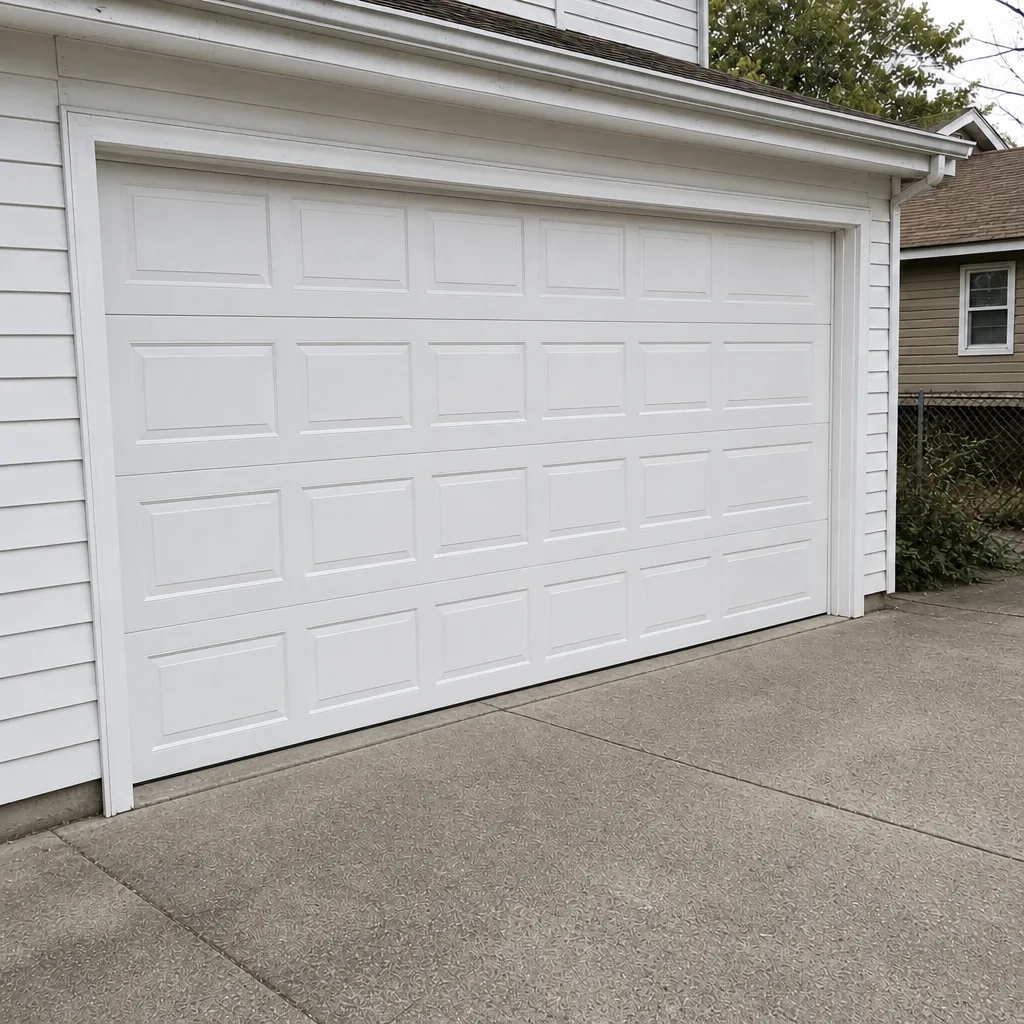 After
When to Call a Professional
Call for a professional if you’ve heard a bang and the door won’t lift, if you see visible cable slack or an uneven door, if the opener hums without moving the door, or if a door reverses and won’t close. Any of those can be dangerous to check by hand or can leave the house exposed, and none of them get better with time. Rarer but worth a call: a bent track section, a rusted-through bracket, or a grinding noise that’s been present for more than a couple of weeks. In our experience, most of these are diagnosable in a single visit and most are repairable without replacing the door. If your door is at the stage where repair doesn’t make sense, we still handle the garage door installation from the same company – no second call, no referral. Akron Garage Door Repair Co offers free estimates in Akron – call (877) 792-5739.
Frequently Asked Questions
The most serious warning sign is a sharp bang followed by a door that won’t lift, which points to a broken torsion spring. The door’s weight is now resting on the opener and cables, so stop using it and call for repair. Other high-priority signs include visible cable slack, an uneven door, and rust-through on a bottom bracket. Call (877) 792-5739 for an exact quote – estimates are free.
Spring repair is priced per spring, and a matched pair is usually replaced together, so the pair costs about twice a single spring. Because prices vary by door size and spring type, we quote each job by written estimate before any work starts. The written estimate sets the final price, so there are no surprises when the invoice comes. Call (877) 792-5739 for an exact quote – estimates are free.
Yes, same-day service is available for stuck and broken doors that create a safety or security problem. Emergency garage door service is a core part of what we do, not a marketing line. Call (877) 792-5739. We answer 24/7. Fast dispatch from 7am to 7pm, Sunday through Friday.
No – the written estimate sets the final price for the job we’ve agreed on. If the technician finds additional problems while working, we talk through the options and the price before doing anything further. You’re never billed for work you didn’t approve. Call (877) 792-5739 for an exact quote – estimates are free.
Yes. The vetted local professionals we connect homeowners with are licensed and insured as their state requires. Our technicians have up to 8 years of experience, and they work across all eight major brands – LiftMaster, Chamberlain, Genie, Clopay, Amarr, Wayne Dalton, Craftsman, and Raynor – so whatever opener or door is already in your garage, we work on your brand. Call (877) 792-5739 to book a free estimate.
A door that opens slowly and closes fast is out of balance, and the spring has the wrong tension. The opener is overworked on the way up and the door’s weight is under-controlled on the way down. That pattern accelerates track and roller wear and strains the opener, and it’s an early sign a spring problem is developing. Have it checked before it becomes a failure. Call (877) 792-5739 for a free estimate.
The Bottom Line
Your garage door is telling you things before it fails – in the sounds it makes, the way it moves, and the rust you can see. A sharp bang and a door that won’t lift is a broken spring. A door that climbs slowly and drops quickly is out of balance. A door that reverses before it closes is more often a limit, board, or force setting than a sensor. Rust on a bottom bracket in an Akron winter is a hardware problem, not a cosmetic one. Catch any of these early and you’re looking at a repair. Ignore them and you’re looking at a failed component chain. At Akron Garage Door Repair Co, we’d rather diagnose the signal than replace the door. Call (877) 792-5739 for a free estimate.
Written by the team at Akron Garage Door Repair Co.